• Pagerank is an algorithm used by google to assign importance of each page in world wide web. The order of search results  depends on the page rank assigned to each page.  A web site has multiple pages and page rank assigned to each page in the web site. The page rank of the page depends on number of external links coming to the page and number of links going out of the page.  The page rank of an incoming link also plays a role on determining the page rank of the page.

    Page rank is used to decide the sequence of search results for a google search. Companies want their page to be at the top of the search result. The easiest way to be at top of the search result is to pay google for the adwords. The sponsored web sites appear above and to the right hand side of its regular search results. 

    Not all companies can afford to pay google for their Adwords. There is cost effective alternative which requires an understanding of how google works.  Google’s internal working knowledge will aid to define  analytical (or mathematical) strategies and implemented in the web site to improve the page rank and eventually with more visitors to the web site.

    To validate the theory with emprical analysis, a plan with following steps drafted.

    1. Find a key word that is not in google’s index server
    2. Create a graph (random graph) and find the initial transition probability
    3. Evaluate the steady state of transition probability matrix using power methods – Which is the page rank of the graph (I will post the technical/mathematical details in a pdf. It is time-consuming to write matrix and other math notation in word press editor)
    4. Develop a set of web sites (pages) adhering to the random graph and each web site to contain the new key word
    5. Allow google crawler to include the new sites in their index server for the new key words
    6. Search for the new key word and absorb the order of search results
    7. Report the results

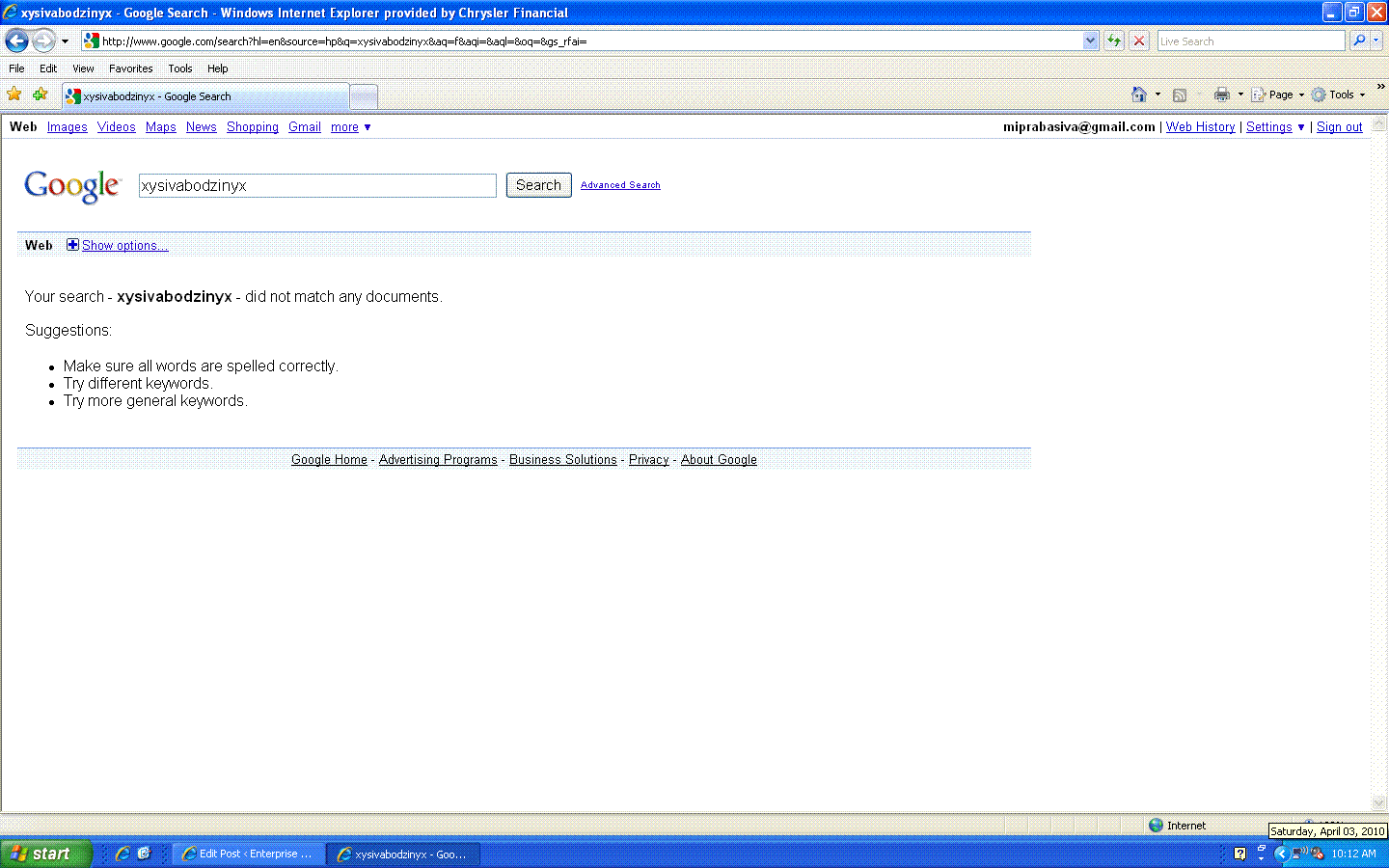
    1. A new key word was selected and  is given below.   There is no google search result for the key word.

    2. The random graph  (a representation of how web sites are linked to each other) and the graph will be implemented  with various blog post and  each blog post will have the key word  adhering to the graph. Each node of the graph denote a blog posting. The links connecting the nodes are the hyperlinks connecting the nodes.

    Note: This page is used for google’s page rank emprical analysis. The links will be created based on the random graph created.  This is node #1 which has the key word:  xysivabodzinyx , xysivabodzinxy . As per the graph, it links out to page 2, page 4

  • The rationale to move towards cost effective private cloud to reduce cost and improve the flexibility to dynamically use the hardware resources and elastically define the infrastructure architecture are defined in the earlier post.   Applications running in the current environment must be migrated to new private cloud to realize the benefit. To illustrate the thought process, the source platform is assumed as a stand-alone HP-UX and AIX platform and target platform is virtualized Intel processor based chassis managed by VmWare ESX cloud operating system.

    Migration steps are given..

    1. Check the applications in the landscape uses COTS (Commercial Off The Shelf) product). Verify from the vendor, the COTS product is supported in the VmWare environment.  If COTS are not supported in the VmWare environment, understand the vendor’s product road map and see if there is any VmWare support in the horizon. Explore ASP model for COTS model.  If it is not feasible, then follow the exception process. (An organization should define an exception process to deviate from private cloud)
    2. Study the technology stack of current application landscape. Verify the technology stack can run in the new host operating system (Linux or Windows).  For instance, if an organization runs the application server BEA WebLogic in HP-UX, in this step, verify if BEA web logic can run in Linux or windows.  There are some technology (like Oracle DB) does not support or perform in VmWare cloud operating system. When a technology is not supported, it is an opportunity to consider that technology for migration to a comparable technology with lower cost and risk and higher or equal benefits.
    3. Even when a current commercial technology stack (like IBM WebSphere, IBM DB2) runs in VmWare platform, still perform a risk assessment of running the native technology stack instead of migration of existing technology stack to private cloud. For example, perform a risk assessment comparing IBM Websphere and native application server JBoss.  The net benefits between these technologies may be equal, in most case, there is a significant license cost differences between these technologies.
    4. Study the migration cost from current technology stack to new technology stack in the cloud. For instance, study how the current technology stack (application server, database server) are currently being used. Look for any proprietary module used by applications in the landscape. For instance, IBM provided CICS transaction gateway jar files in older version of websphere. The applications in the landscape may be still using it. Watch for it. CTG jar files are not part of J2EE specification when IBM bundled with their product. Later, Java connectors for CICS are made available. If there are applications in the landscape using more proprietary modules/tools, then migration of application from websphere to JBoss will be a significant effort.  Total cost of migration must be taken in to consideration. It is a not a best practices to run any vendor proprietary technologies in the mission critical application in the landscape.
    5. Repeat step 2,3,4 for all elements in the technology stack. (like database, security access management, data ware house, back office systems and etc)
  • In a stand-alone hardware infrastructure, adding an extra memory or CPU to a hardware unit may take 3-5 months time involving various members following various internal processes like purchase request, infrastructure internal process, service provider internal purchase process and etc. The longer lead time and more involvement from various teams are required because of current enterprise hardware design. Most of  IT organization has more stand-alone servers and it limits the flexibility to add additional resources to the servers.
    Due to above reasons, during the initiation phase of any project, the lenient hardware capability planning is done.  It is not ideal nor cost efficient.  This problem can be solved by procuring a bigger server and partition it as need arises. The concept has been in use in mainframe platform for last three decades and each partition in mainframe is called LPAR (Logical PARtition). The similar concept proliferated in the Unix world and major Unix operating systems AIX, Sun Solaris and HP-UX supports it now.
    Operating systems Aix, Sun Solaris, and HP-UX run on their host RISC processors from IBM, Sun, and HP respectively.  RISC processor are designed for high volume high speed processing  there is a perception within IT leadership team including  CIOs that only the RISC processors are suitable for data center operations.    The cost of virtualization operating system and blade chassis hardware for RISC based server farm are more expensive than CISC (Complex Instruction Set Computer)processor (like Intel Xeon, AMD) based server farms.  CISC processor based servers had the perception that it is meant for a small scale business and not ready for enterprise data center operation.  It has been a challenge to enterprise architects and IT strategist to convince the IT leadership team to re-platform the existing expensive and inflexible stand alone RISC based servers.

    Popularity, acceptance, and adoption of social networking platforms like web 2.0 indirectly helped IT leadership team to rethink about their perception on the CISC based servers for data center operations.  The popular social network sites like facebook runs on Linux platform and the number of users in social networking sites exponentially growing.  It is empirical proof that CISC processor based server are ready for high volume and high-speed data center operations.

    With current economic climate, IT leadership team in all sectors have the following objectives.

    • Reduce infrastructure cost (Capital Expense, CAPEX)
    • Reduce over all data center operation cost  (Operational Expense, OPEX)
    • Utilize more energy-efficient (for both Green and cost purpose) devices
    • Minimize lost revenue due to down time

    The above objective can be met by developing a cost-effective private cloud. It will additionally provide more flexibility and enable the organization to become  more nimble and agile.

    How to architect the private cloud?

    First and fore most, cloud operating system is required to manage a set of hardware to virtualize it to create virtual image.  There are two types of cloud operating system available.

    1. Hosted Server cloud operating system
    2. Bare-metal server cloud operating system

    1. Hosted server cloud operating system requires a host operating system. The cloud operating system runs on top of the host operating system. The devices are directly managed by the host operating system. It is not designed to clone the operating system and create an image. It is primarly dessigned to clone an application. It is not recommended to run the data center operation like data ware house.

    2. Bare-metal server cloud operating system has a micro kernel to manage all hardware directly. Generally the micro kernel is developed very effectively. There are open source cloud operating system available. If you are running mission critical  system, it is highly recommended to run under the commercial cloud operating system. VmWare ESX Server is one of the popular commercial cloud operating system. The micro kernel of VmWare ESX  written very effectively and does a great job of managing the resources.

    What are the hardware requirements for private cloud?Well, it depends. There are quite a few certified hardware providers supply servers to  run under VmWare ESX Server. All major manufacturers like Dell, HP, IBM, Fujitsu hardware both blade and racks runs under VmWare ESX Server.  Similarly major manufacturers in storage area network, SCSI controllers, RAID controllers, Fiber Channel adapters, Ethernet Nic support VmWare ESX. Select the hardware, memory and storage based on your needs. There are guidelines available to select the hardware units. Those guidelines will be followed based on the need.

    What are the target operating systems ?Well, again, it depends on the requirement. It supports both Linux and Windows. It support all major flavor of Linux (like Redhat, Novel SuSE) and Windows server platform. VmWare ESX can support both operating system at the same time.  The size of the image can be selected based on the requirement.

    Results

    With the private cloud architecture using Intel/AMD processors, all the above objectives are being met.