• Strategy Formation Process:

    In general, the strategy formation process is straight forward. The process brings all key factors for consideration before the strategy is formed. Participation of all strategy formation stakeholder of the organization brings the internal and external reality, strength, weakness, opportunities and threats into the process. All organization exists for a purpose. The core objective of any profit organization is to create value to customer and generate profit to the share holder or the owner of the organization. The value dynamics is applicable to all profit organization. The value to the customer is generated by providing a product or service.

    The steps involved in the competitive strategy formation are listed below.

  • Identify the stakeholders need to be involved in the strategy formation.
  • Provide an overview of the strategy formation process to the stakeholders
  • Formalize the stakeholder’s consensus on the purpose of the organization, the core business functions and value proposition to drives value to the customer and profit/loss to the share holders or owners of the organization.
  • Identify the key differentiators in the market segment and perform a feasibility assessment to its value
  • Formation of the vision, mission, goals and core value of the organization to illustrate the key differentiators in the market segment.
  • Identify the key words in the vision & mission statements with respect to finance, customer, process and people.
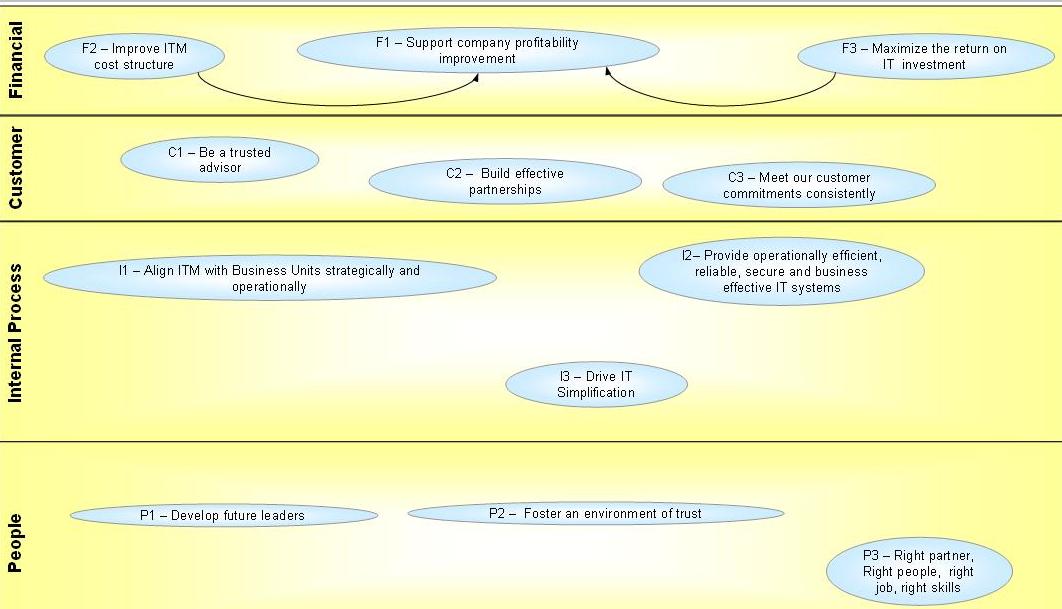
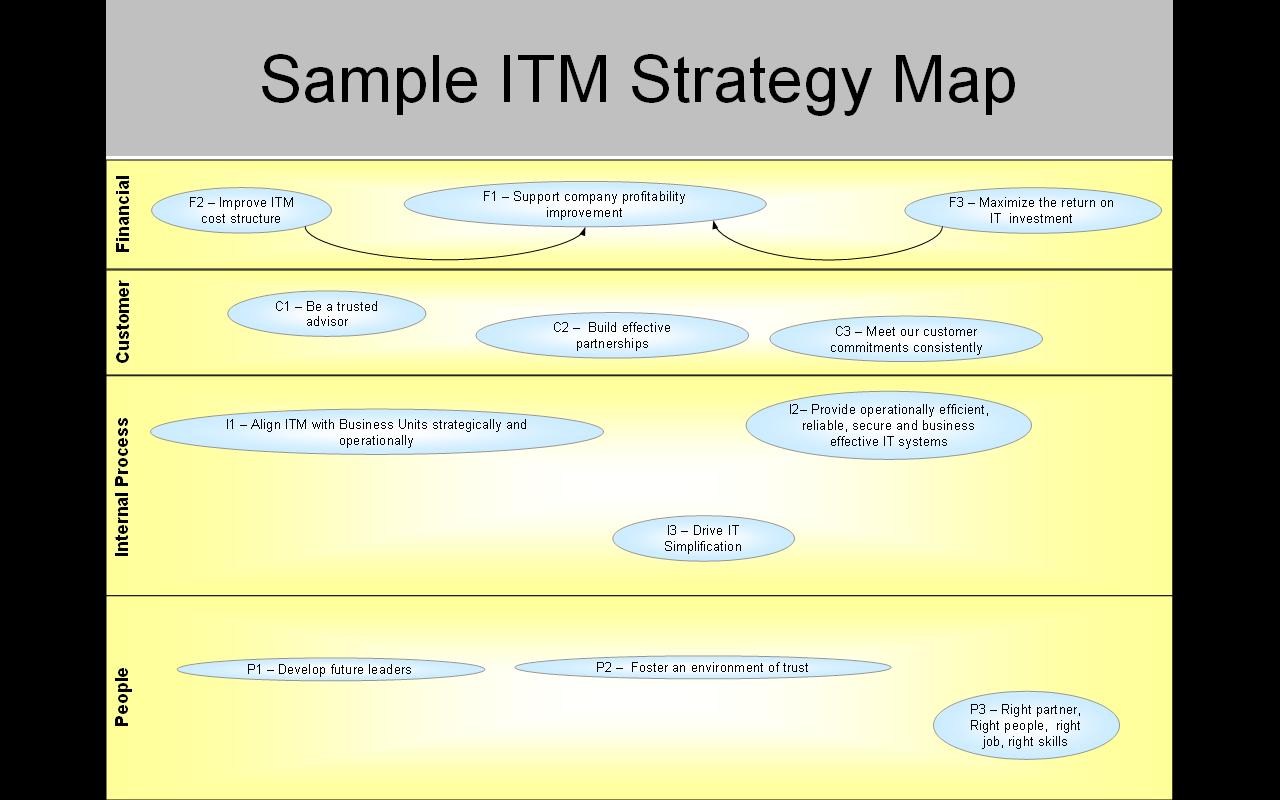
  • Create a strategy map. Strategy map is a representation of the strategy. Strategy map has four perspectives. They are finance, customer, process and people (or learning and growth)
    1. Review four perspectives of the strategy map and its alignment. Choose learning & growth or people perspective based on the organization.
    2. Identify the strategic objectives for each perspective and emphasis on the identified key words from the vision and mission statement.
    3. Describe each strategic objective by a vivid statement
  • Identify the key performance measures for each objective.
    1. Assess the feasibility and availability of metrics for the key performance measures.
    2. Refine the key performance measure if the metrics are not available with in the organization and unrealistic to generate the metrics.
  • Create the targets for each performance measures
    1. Set the target for the long term
    2. Incrementally assign the targets into different duration. (per year or per quarter)
  • Identify the initiatives to meet the targets for each duration
    1. Theme is a group of the related initiates in duration.
    2. Identify a theme owner
    3. Identify a owner for each initiative
  • Create the balanced score card
  • Communicate the strategy to the organization and align the organization to the strategy
  • Identify the program management office to track all the initiatives
  • Track the status of the initiatives and fine tune the initiates based on the progress
  • The core challenge in the strategy formation is to identify the differentiators. Even when an organization has a differentiator in the respective market segment, implementation of the strategy is critical for the organization success. Execution of the strategy contains two major parts. One is to identify the projects or initiatives and second part is to align the whole organization towards the strategy.


  • Strategy and enterprise architecture are the most frequently used and misused words in corporate America. The understanding of the real concept and utilization of it for the organization benefit has been increasing significantly in recent years. Let me attempt to generalize the IT strategy framework and explain how it fits with in over all organization.

    In general, strategy is a long term plan. When I say it is also widely misused, I mean, I heard in lots of discussion that someone is going to come up with strategy to solve a production problem. Production problem is the one, which needs immediate solution. It does not require long term planning to solve an immediately required solution.

    Strategy in other words, when we were kids, we all had ambitions. Those ambitions were strategies if some one work towards to accomplish it. If some one had ambitions but never worked towards to accomplish it, then it was not a strategy it was a dream.

    Before we jump into IT strategy, let us discuss types of strategy.

    • Corporate Strategy
    • Competitive Strategy
    • Functional strategy
    • Military Strategy
    • Political strategy

    I’m not an expert in both military & political strategy. May be after few years, I will look into the military strategy (will start from art of war) & political strategy frameworks.

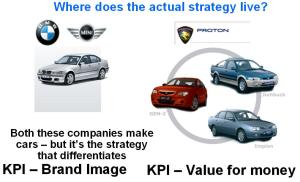
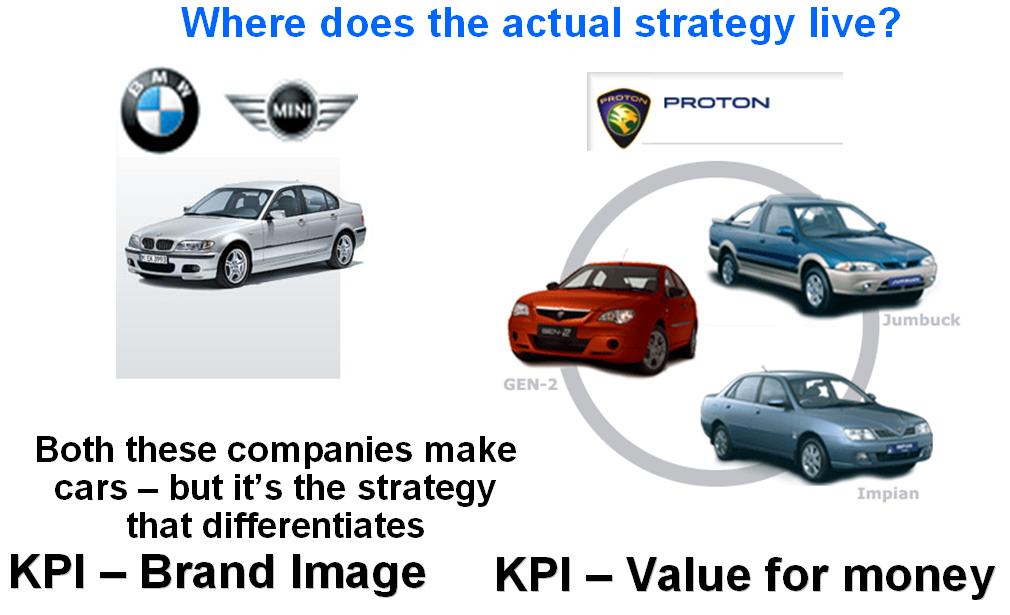
    Competitive Strategy:Almost in every market segment, there exist immense competition. The company wants to differentiate themselves from their competitors by doing something different than others. Cost, quality, heritage, brand identity are few differentiating attributes. Competitive strategy is a long term plan to uniquely differentiate & recognize the company among their competitors. For example, Target & Walmart are in the same market segment.
    Car Strategy

    Walmart’s competitor’s strategy is to provide the goods for the lowest cost possible. The customer who look for the lowest cost always prefer the Walmart stores. There are few grocery stores like Trader’s Joe in the same market segment like Walmart but adopt a different competitive strategy. Their differentiating attributes are not cost, but unique products with quality customer services. The customer who are willing to pay extra for preferential treatment and unique products (like organic, healthy, etc) will prefer Trader’s Joe store than Walmart.

    Corporate Strategy:

    Corporate strategy is a long term plan to align the entire organizations to support the competitive strategy. It is to line up the employees, contractors, right sourcing partners, consultants, partners, internal processes, external processes, tools, software, systems, business model to support the corporate strategy in turn to support the competitive strategy. For example, Trader’s Joe will look for the partner who provides the unique products like organic foods, low gluten, heart healthy, fat free, low sodium, etc and hire employees are naturally friendly to everyone. A strategy person could do reverse engineering and figure out the strategy by closely watching their actions.

    Functional Strategy:

    Functional strategy is a long term plan of the functional organization (like HR, IT, Finance, etc) to support the corporate strategy. The functional strategies should support other functional strategies and the corporate strategy. IT strategy is a functional strategy which supports the corporate strategy.

    IT Strategy:

    It can be formed by following any methodology. The concept is more important than the methodology. IT exist for a purpose. The purpose should be clearly understood by the IT organization. It is natural for the IT organization to be technical and lose sight of the business. That is an ignition for the IT failure eventually. For discussion purposes, I will take Kaplan and Norton strategy formation process. There are four perspectives in this framework. Learning & Growth (or people), Internal Process, Customers & finance. The concept is, there is should be dedicated focus in each perspective and if we have a right people & process, the company will have more customers, and if we they have more customer their finance will be have a positive impact. If their finance has a positive impact, then the profit organization will meet the share holders (or owners) expectation. Very simple and straight forward.

    To support the corporate strategy, the IT strategy will have these four perspective. Each perspective will have set of strategic objectives. As I stated above, strategy is long term plan and we have to work daily towards this long term plan. To work daily on the the long term, we need to have a focus area (say for the current year). What we want to accomplish in the direction of the strategy. The focus area is other wise called Themes. Theme (or focus area) are the organization goal for that year which aligns to multiple objectives across the perspectives.
    Themes will have a set of performance measures (or the strategic objectives). Each performance measures will have a target for that year. For each target, there are set of initiatives and the entire organization will be work on those initiatives.

    It is a straight forward easy to understand management concept which is very powerful.

    This strategy formation process can be used to create corporate or competitive strategy.
  • As eloquently stated in the Kung Fu Panda movie, Yesterday is history, tomorrow is mystery and today is a gift and that is why it is called “present”. Well, almost all the spiritual studies tries to communicate the same in a different forms. There is a profound message behind it. Let me explain it in my own words and relate how it helps a strategy person to be more effective.

    The moment you think about what is going to happen or/and what happened, then you lose 100% focus on what is going on now. It is very similar to Markov’s theory (ie. Markov Decision Process or Markov Chain). Markov had this great insight that when you hear a music, the melody of current note of the music only depends on the previous note. In another example, let us take a lotus pond with full of leaves. Let us say there is a frog on a leaf and the frog constantly jumps from one leaf to another. The next location of the frog (x+1) only depends on the current position (x). Markov’s stochastic process theory has been extensively used in the inter networks. That is, the tcp/udp packet which looks for the next hop (using the routing table) only depends on the current node.

    Only the current state matters to go to next step of the future state.

    I can imagine some of the logical minds are wondering, how could an IT strategy person not use yesterday’s information and tomorrow’s approximation. If you were wondering, that is very logical.

    The moment you live 100% of the current second, that event will become part of your life and information gathered will be part of you. The information gathered during that second will be integral of your thought process. You do not need to put an effort to think and recollect it. It is just a part of you and it naturally comes to you with out an effort.

    Truly living the present in other words is living with no mind. Mind is a negative phenomena. No mind is a positive phenomena. No mind does not mean do not use the mind. The moment you live with no mind naturally (no mind can be attained by using drugs too and that is why, you see some people bring out their true nature when they are in drugs like alcohol) then you attain bliss. There are lots of techniques available (like meditation) to attain no mind naturally. Once, someone lives with no mind naturally (with out using drugs and with out putting an effort) they can use the mind whenever they want. The mind will become like your body parts. If you want to run, you can run and if you do not want to run, you can simply sit and rest your legs.

    Mind is a self image created by the environment about self and environment. Dropping the mind and seeing things as is, helps to drop the self and preconceived notions. Everything will be viewed objectively and there is no room for emotions. Understanding things “as is” objectively is very critical to the IT strategy person to study the current state and expected future state.

    To figure out the future state, the mind will be asked to be functional to study, predict and approximate the future.

    Understanding this profound subtle message helps a strategy person to be very objective and it is required by strategy person more than any one in the IT organization. Understanding and using this spiritual knowledge not only helps the strategy person to be effective, it will help the organization to be successful to attain the over all goal.